
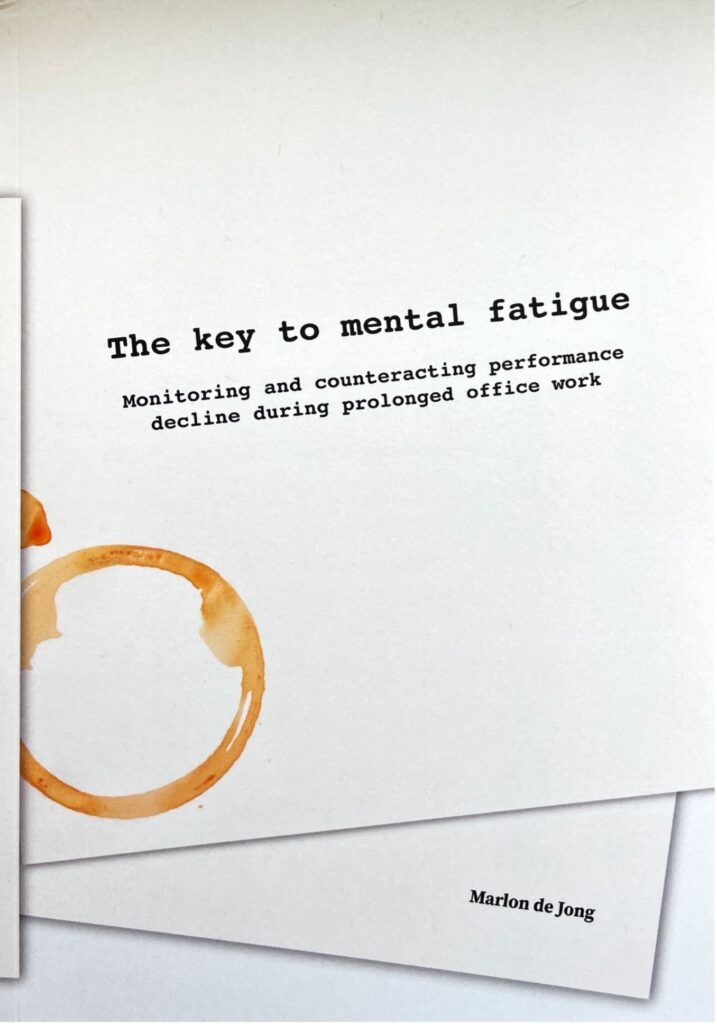
Patterns in typing behavior are sensitive to the effects of mental fatigue, both in an experimental setting and in a work environment. Psychologist Marlon de Jong concludes this on the basis of extensive research into patterns in typing behavior and underlying brain activity during office work. In her research, De Jong shows that younger people type slower and less accurately when they are working for a longer period of time. Older people, on the other hand, continue to perform as accurately after two hours of typing as when they first started the task, however, they do become slower over time. These changes in typing behavior can be used to provide feedback to the employee, but also provide valuable information for research in the work environment. Behavior can be monitored continuously without having to interrupt regular work activities. This makes it is possible to investigate how (older) employees could be supported in creating more optimal working conditions, for example by planning breaks at the right time. In addition to the well-known positive effect of breaks, caffeine could be used to counteract mental fatigue. De Jong and colleagues have shown that it is better to focus attention on important information in the environment after a cup of coffee. This is an advantage in a dynamic work environment, where it is important that information that is vital for the task at hand is properly processed.
Comments are closed